The Song Is Found in the Repeat: Inside an Experimental Music Production Workflow

The first version is not the song.
What returns when the signal refuses to settle?
No answer.
Only the next pass.
The Hand
At Atomic Phonographs, the process begins with handwriting.
Eric writes the lyrics by hand.
Before the generation.
Before the arrangement.
Before the sound has a shape.
The words arrive first as fragments, images, questions, and pressure. They may describe a clear thought, an undertow, a weather system, or a door left open.
The page holds the center.
Everything else moves around it.
The Machine
Then Suno generates the music.
It produces possibilities.
Not decisions.
A first rendition might reveal a melody. Another might find the right atmosphere. A third might introduce something unexpected: a vocal movement, a rhythm, a change in temperature.
Some versions feel close.
Most do not.
The generated material is not the finished track. It is a field of signals. A collection of doors.
Someone still has to decide which one opens.
That is where our experimental music production workflow begins to separate from the idea of a one-click song.

The Loop
The process is simple to describe.
Write.
Generate.
Listen.
Reject.
Tweak.
Edit.
Crop.
Fade.
Send it back in.
Repeat.
A typical song moves through roughly 50 to 75 iterations.
Some arrive after 10 renditions.
Some move closer to 100.
There is no reliable number. No clean formula. No button marked finished.
The work changes with the song.
A track may need a different opening. A shorter ending. A cleaner vocal. More tension. Less movement. A different balance between atmosphere and momentum.
Sometimes the right version is almost present.
Sometimes it is buried inside a version that seems unusable.
The repeat exposes it.
The Judgment
Iteration only matters when someone is listening closely.
The machine can generate options quickly. It cannot decide which option belongs to the song.
That requires judgment.
Directing.
Rejecting.
Refining.
Recognizing.
The human role is not limited to writing the first instruction. It continues through every return.
What should remain?
What should disappear?
Where does the track become more itself?
Where does it become less?
These decisions are often small.
A crop.
A fade.
A pause.
A repeated phrase.
A version saved instead of discarded.
Together, they create identity.
This is the center of AI-assisted music production for us. The tool expands the search. Human taste gives the search a direction.
The song is not hidden inside the first output.
It appears through comparison.
The Pulse
Repetition can become mechanical.
It can also become alive.
The difference is attention.
We are not repeating the same action without thought. We are listening for change. Each iteration carries something forward. Each one removes something that does not belong.
The process becomes a pulse.
Generate.
Hear.
Decide.
Return.
At first, the possibilities are wide.
Then they narrow.
A certain tone keeps coming back. A particular rhythm survives the cuts. One emotional temperature refuses to leave.
That persistence matters.
It may be the song asking to be recognized.

The Catalog
The Atomic Phonographs catalog is a record of these searches.
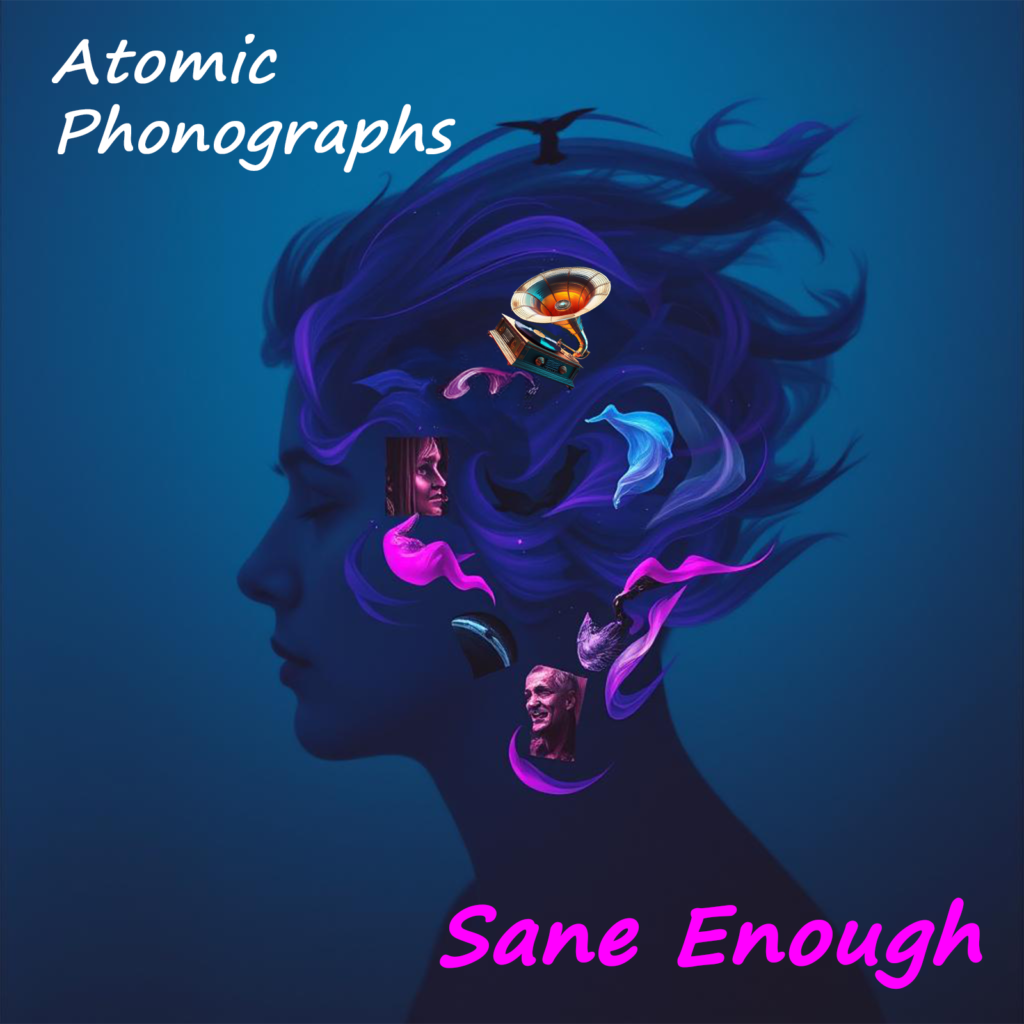
Sane Enough holds the first clear thought.
Swallowed Me moves beneath the surface.
Turmoil carries weather systems within it.
Mountain Man takes the longer view.
I’m Good lets the light back in.
Hall of Mirrors looks twice.
Should I Try finds the next small yes.
It’s Ok to be Happy leaves a door open.
Powder Face stays pinned.
The tracks do not need to share one genre.
They need to share an intention.
A flexible archive.
A recognizable atmosphere.
A willingness to follow a sound until it becomes unmistakably itself.
Explore the Atomic Phonographs music catalog to hear where the different paths lead.
The Human Center
There is a familiar question around generated music.
Is it real?
The question is useful because it remains difficult.
The answer does not sit entirely inside the tool. It sits inside the process.
Eric writes the lyrics.
Suno generates musical material.
A human listens across dozens of versions.
A human chooses what survives.
A human decides when the track has found its emotional center.
This does not make the machine invisible. It makes the relationship visible.
The finished song exists somewhere between intention and emergence.
That space is not a weakness.
It is the interesting part.
In an independent music producer’s workflow, the instrument may be unfamiliar. The decisions are not. Taste, restraint, instinct, and revision remain essential.
The same is true for an indie record label, an independent record label, or an indie record company. The tools may change. The responsibility to choose does not.
Not Push-Button
A push-button process suggests that the result is immediate.
Our process is not.
The first generation is only an invitation.
The useful work happens afterward.
We listen for what is distinctive. We remove what feels generic. We hold onto an accident if it creates a stronger world. We return to an earlier version when a newer one has lost the center.
The goal is not perfection in the abstract.
The goal is recognition.
There is a moment when the track stops asking what it could be.
It begins to answer.
That moment may appear in the tenth rendition.
It may wait until the ninety-eighth.
The number does not matter as much as the arrival.

Alternative Rooms
Experimental music production does not have to mean noise without structure.
It can mean allowing the structure to emerge differently.
Underground music production often begins without a fixed map. It follows texture, instinct, and pressure. Alternative music production can do the same while remaining welcoming, melodic, and clear.
That is the balance we look for.
Something unusual.
Something listenable.
Something with enough space for the listener to bring their own meaning.
An underground music label does not need to explain every decision. It needs to make the decisions feel intentional.
The music can remain open.
The process can remain honest.
The Final Pass
The last version is still a decision.
We check the shape.
The beginning.
The middle.
The ending.
We listen for the point where the track loses energy. We listen for a section that stays too long. We listen for the fade that arrives at the right time, or the crop that leaves the right amount of silence behind.
These edits are not decoration.
They change the memory of the song.
A track can become heavier through subtraction.
It can become brighter through restraint.
It can become more direct by leaving one strange element untouched.
The final pass does not erase the iterations.
It contains them.
Keep Listening
The catalog is growing.
New tracks enter the room.
Older tracks change shape when heard again.
That is part of the reason we release across different moods and styles. Focus, friction, movement, memory. A little atmosphere. A little voltage.
The work belongs to an independent music and visual project built for the in-between.
Listen through the Atomic Phonographs discography, or find the releases on Spotify, Apple Music, and YouTube Music.
For broader context on iterative workflows, Kits AI’s music production guide and The Pro Audio Files’ experimental production piece offer useful neighboring perspectives.
The Repeat
A song is not always found by moving forward.
Sometimes it is found by returning.
One more rendition.
One more listen.
One more cut.
One more refusal.
The repeat is not a delay.
It is the method.
It gives the sound enough time to reveal its boundary.
Enough pressure to reveal its shape.
Enough silence to reveal what remains.
Are we real?
Are you?
The question stays open.
The song keeps moving.
Penny